Note: From Jan to Feb 2018, the author worked as a researcher-in-residence at Kunci Cultural Studies Center, Yogyakarta, supported by NML Residency & Nusantara Archive Project. Yogyakarta has been the center of Indonesian arts and culture, with many independent cultural and art spaces established after 1998, providing alternative knowledge outside the academia. During the residency, the author investigated Kunci’s new “school” which is said to be inspired by Taman Siswa, an education movement and school founded in 1922 in Yogyakarta.Founded in 1922 in Yogyakarta, Indonesia, Taman Siswa was an alternative school to the Dutch colonial education system. Its teaching method is called “Among” (means ‘education’ in Javanese), which aims at cultivating students to move according to their natural character, to maintain freedom, peace and order of their body and soul. As such, the school not only taught general subjects such as language, science and economics but also traditional Javanese music and art. Taman Siswa did not set the pursuit of knowledge and enlightenment as its only and ultimate goal; rather, it simultaneously stressed the importance of feeling, thinking and experiencing in the process of developing nationalism, personality and culture. It is hard to imagine that, by 1930s and 1940s, Taman Siswa became home for many anti-colonial and nationalist activists and artists.
2018/04/18
[Show Ying Xin] Exploring the Contemporaneity of Taman Siswa, Rethinking Alternative Education in Indonesia
(Author: SHOW Ying Xin/ original link)

2018/03/27
[Syafitudina] Something About Nusantara, the Listening, and the Project of Decolonization
(Author: Syafiatudina; translated by Rikey Tenn [CH] / original link)
Note: This article is written by Syafiatudina, a member of KUNCI Cultural Studies Center in Yogyakarta, for “NML Residency & Nusantara Archive” as the presentation of her residency in Taipei as well as the feedback for “Nusantara Archive.” In the writing, she refers to the reason for selecting the 228 Memorial Park (or New Park from Japanese colonial times to the KMT’s party-state rule) as the creative background and spatial coordinates of the final proposal of her audio-guide project - because of the park’s history that connects the life experiences of marginal/fugitive people under different regimes. In addition, her writing as a reminder sheds light on the competence of the “Nusantara Archive” as a decolonization project to showcase the alternative worldview manifested by the Malay Archipelago to stand firm against the desire of imperialist expansionDuring my residency in Taipei, I have been looking for archives and references on the connection of Indonesia and Taiwan, both historically and contemporary. This search had brought me to museums and libraries. I’ve been flipping through books about the Dutch and Japan colonial regime in Taiwan while tried to compare it with the colonial time of Indonesia. Though the archives and references on Taiwan-Indonesia connection are not only stored in library and museum. The narrations of the two regions’ relation are embedded, yet also fragmented, in the city landscape and its inhabitants. In this regard, I have developed interest on the Taipei’s New Park (or what’s known now as 228 Memorial Park) because of its historical and political significance which spans through different regimes in Taiwan up until now."
2018/03/06
[Wu Chi Yu] Map Projection: Notes and Misreading of the Video Making in Kota Bharu
(Translated by Alex Ma; proofread by Hoo Fan Chon / original link)
World Map
The world map captured through the lens seemed a bit deformed—Asia and Africa, especially the regions near the equator, were not as elongated as we would normally expect. There were many travel information and maps, including Redang Island, Perhentian Island, and this distorted world map, posted on the walls of the B&B we stayed at in Kota Bharu, the capital city of Kelantan. This B&B was recommended by Zaidi Musa, the owner of the bookstore Kedai Hitam Putih and the person we were going to interview. These maps had detailed information, but in contrast to our impression, the world map referred to as “Gall-Peters projection” corrected the issue of obvious enlargement of high-latitude countries in the more commonly seen Mercator projection maps, where European and American countries with higher latitudes were enlarged, which made other Asian and African countries located near the equator seem smaller than their actual sizes, further diminishing the importance of these countries that were already relatively weaker in terms of economic and political power.
Note: For the collaborative publication project by artist Wu Chi-Yu in tandem with “Nusantara Archive,” the artist interviewed two independent bookstore owners – Zaidi Musa and Ezzmer Daruh – in Kota Bharu. After the trip to Northern Malaysia, Wu gathered the traces of “map projection”, what he had seen at the weekend market, and conversation questions like “where are you from?” as well as “where are you going”, and then rewrote the collective misreading of images and interpretation of experience regarding the faraway land, the past as well as the past of the faraway land.
World Map
The world map captured through the lens seemed a bit deformed—Asia and Africa, especially the regions near the equator, were not as elongated as we would normally expect. There were many travel information and maps, including Redang Island, Perhentian Island, and this distorted world map, posted on the walls of the B&B we stayed at in Kota Bharu, the capital city of Kelantan. This B&B was recommended by Zaidi Musa, the owner of the bookstore Kedai Hitam Putih and the person we were going to interview. These maps had detailed information, but in contrast to our impression, the world map referred to as “Gall-Peters projection” corrected the issue of obvious enlargement of high-latitude countries in the more commonly seen Mercator projection maps, where European and American countries with higher latitudes were enlarged, which made other Asian and African countries located near the equator seem smaller than their actual sizes, further diminishing the importance of these countries that were already relatively weaker in terms of economic and political power.
2017/11/01
An Audio Guide for the Netherlands East Indies exhibition at the Tropenmuseum by KUNCI Cultural Studies Center (Excerpt)
Note: The article is an excerpt of the audio guide which is a site-specific project realized by KUNCI Cultural Studies Center (Yogyakarta) in the Netherlands East exhibition at Tropenmuseum. It was produced in KUNCI’s 6-week research residency at the museum; a project facilitated by the independent platform Heterotropics and the Research Center for Material Culture. The audio guide can be listened online or in the museum. The storyline serves as an alternative reading of the objects displayed in the permanent exhibition since 2003. The exhibition is fashioned as a colonial theater through life-size mannequins and artifacts, which aims to provide the audience with narrative sceneries of the daily life in "East Indies", exploring realms such as ‘Education’, ‘Art’, ‘At Home’, ‘Commerce’, ‘Discovery’, and ‘Presentation’. With the voice of "Sulastri", the main character of Suwarsih Djojopuspito's Buiten het Gareel, the listener find in it the representation of the museum’s gaze as well as a medium for reclaiming colonial history, both are the very elements of this figure of the East Indies woman.POINT ONE
STAND IN FRONT OF SULASTRI'S MANNEQUIN (EDICATION IN EAST INDIES). YOU CAN CHOOSE TO STAND IN THE POSITION WHERE YOU CAN SEE ALL THE BOOKS AND OTHER TEACHING MATERIALS IN NETHERLAND EAST INDIES THAT KEPT ON THE VIRTRINES. OR YOU CAN ALSO STAND IN FRONT OF THE SCREEN THAT PLAYS THE FOOTAGE OF THE IMPLEMENTATION OF THE SCHOOL DURING THE PERIOD.
2017/10/17
[Hoo Fan Chon] How to cook Asam Laksa with Tilapia
(Author: Hoo Fan Chon / Original link)
Note: The Tilapia fish, or more commonly known as the Wu Guo Yu in Taiwan has a humble origin. However, it has a captivating story to tell as in how it was introduced to Taiwan by two Taiwanese soldiers from Singapore in 1946. The advancement in fish farming technology and the unintended yet colourful branding exercise have gradually promoted this fish as the national sea bream of Taiwan. This sharing session is based on the study of Wu Guo Yu, to look at the form of migratory movement through livestock, the process of domesticating a foreign species and its cultural significance in constructing a national narrative. A Wu Guo Yu sample dish will be served during MNML #19. The artist will like to thank Digital Art Foundation, Taipei for the invitation, OCAC for hosting the residency, and friends from the local art community for their advice and support during his one month stay in Taipei. To revisit the place where Wu Guo Yu was initially brought in from, the artist chose to cook Asam Laksa with it by adding a Nanyang flavour to the supposedly naturalised foreign species, as a gesture of homecoming.
2017/10/15
[Okui Lala] A Proposal for Our Future Mother Tongue
(Author: Okui Lala/ Original link)
Note: The article is rewritten from the transcription of the NML Residency & Nusantara Archive Project, Meeting NML #18 on 5th, Aug, 2017. The artist imagines our collective identities through language connections and disconnections. In this artistic research, her language proficiency became her tool and boundary: Bahasa Malaysia, Mandarin, English, Hokkien; and within them, the language politics, the accents, the unwritten. Interpretations were based on introduction through language teachers as well as conversations with Malaysian artists, who are and were based in Taiwan. Moving back and forth between the bridges and gaps of the past and contemporary signifier/signified, what will then be the possibilities of our mother tongue and lingua franca in the future along with the development, re- or non-development of the current ones?Before I begin my presentation, I would like to play two short videos for the audience. The first video is 'How do we meet? How can we meet?' (2016), a video I made during my residency in Thailand. In the video, the old lady and I repetitively read a chant in some languages, during which we spoke in Teo Chew, besides Thai. The second video that I'm going to share is the beginning from ‘My Language Proficiency’ (2017). Here is the excerpt from the video:
2017/10/10
[Zikri Rahman] New Youth Cultural Movement in Malaysia: A Conversation with Zikri Rahman, Co-founder of Buku Jalanan
(Author: SHOW Ying Xin; translated by Kris CHI [English] / originally link)
Note: As a young Malay activist on the street, Zikri Rahman consistently embarks on various interdisciplinary socio-political and cultural activism projects, including Buku Jalanan and Idearaya Festival. Currently, he is doing a cultural and literary mapping project of Kuala Lumpur through the lenses of literature with LiteraCity. This is an interview conducted by Show Ying Xin on Malaysiakini in 2017.
"Reading should be encouraged at all times, with an effort to promote books that are worthwhile and that enlarge the recruit's facility to encounter the world of letters and great national problems. Further reading will follow as a vocation; the surrounding circumstances will awaken new desires for understanding in the soldiers. This result will be produced when, little by little, the recruits observe in their routine tasks the enormous advantages of men who have passed through the school over the remainder of the troop, their capacity for analyzing problems, their superior discipline, which is another of the fundamental things that the school should teach."“Which book influences us? That must be Che Guevara’s Guerilla Warfare.” Zikri Rahman is in black with tied curly long hair. His words reveal the ideas and resolution of the left-wing youth.
--Ernesto Che Guevara, Chapter Three in Guerrilla Warfare
[WU Chi Yu] The Reading List Project: Interview with Kitartb, the independent bookstore in Kota Bharu
(Translated by Okui Lala [English] and Rikey Tenn [Chinese] / original link)
Note: The "Reading List" Project is the collaborative publication between artist WU Chi-yu and Nusantara Archinve. As the pre-text of his work, WU interviewed with two independent bookshops based in Kota Bharu, Kelantan, with the help of artist Okui Lala and cultural worker Wan Atikah. They are Ezzmer Daruh of Kitartb and Zaidi Musa of Kedai Hitam Putih. They've different styles and experiences, and both devote to the alternative practices of knowledge production. The project contains interviews published in English and Chinese, and the notes of WU in the process. They also transform into his new video works. Through the reading list recommended by Ezzmer and Zaidi and their alternative strategies, the viewers see the local reading condition and their values behind the messages they've sharedKitartb is an alternative bookshop, which I started in Kota Bharu since May 13th 2016. I use the term ‘alternative’ because there are existing bookshops in Kelantan but they mostly sell books to students. From this perspective I thought of what was lacking in Kota Bharu. The relationship between books and readers, books and the public should be more intimate than that. ‘Alternative’ means working together on more events provided by the public. To Kitartb, Kalam[1] is the support team. If Kitartb is a house, Kalam are those living inside it. On the surface, I run and manage it, but Kalam will back it up with support.
2017/07/01
[Au Sow Yee] Scenes of Magic Realism in “Malaysia, Truly Asia"
(Author: Wang Po-wei; translator: Cliff Chang/ Origin link)
This article originally stems from the Meeting No Man's Land series: “Art-in-Production 2: Yao Lee Chun + Au Sow Yee”, organized by No Man’s Land. Yao, Lee-chun, the director of Guling Street Avant-garde Theatre was invited as the moderator for Malaysian artist Au Sow Yee on the “real” Asia [1], of which the seemly bizarre problematization was inspired by “Malaysia Truly Asia”, the official tagline by Ministry of Tourism and Culture Malaysia. Series of video advertising with the tagline stress the “real” Asia lies in the harmony of multi-ethnicity and the diversity of lifestyles in Malaysia.
This article originally stems from the Meeting No Man's Land series: “Art-in-Production 2: Yao Lee Chun + Au Sow Yee”, organized by No Man’s Land. Yao, Lee-chun, the director of Guling Street Avant-garde Theatre was invited as the moderator for Malaysian artist Au Sow Yee on the “real” Asia [1], of which the seemly bizarre problematization was inspired by “Malaysia Truly Asia”, the official tagline by Ministry of Tourism and Culture Malaysia. Series of video advertising with the tagline stress the “real” Asia lies in the harmony of multi-ethnicity and the diversity of lifestyles in Malaysia.
2017/06/27
Sound Route: Three Notes on Geography
(Author: Wu Chi Yu,Shen Sum Sum, and Musquiqui Chihying; translated by Zoey Wu / Original link)
Crossing the Sea
Contemporary art as an interdisciplinary subject is never the accumulation of a certain knowledge. Tossing on the sea of social science research, art creation unfolds a piece of tiny and irregular multidi-mensional space for the diverse currents to encounter and merge, so that human can take the opportuni-ty to think back over the modernity. Upon a research item of Taiwanese old song, the story of a girl who was inclined to tragic character caught our attention. In comparison to other Taiwanese Hokkien love song, the depiction of this girl’s hybrid appearance in the lyrics clearly offers more traces on early trade history under globalization rather than just shows the scene of self-pity loves.How did the lyricist Chen Dar Ru find the background of Ms. Kim? And who exactly did Ms. Kim long for – the employee from Dutch East India Company or the doctor from British caravan on ship? We do not have the confi-dence to answer all these subtle historical questions, but coincidentally we found the spirits of Ms. Kim in many difference references. These spirits not only embody Ms. Kim’s self consciousness but also – to be more precisely speaking – they appear like Ms. Kim’s reincarnation.
 |
| Leaping North from the seaside wetland on Java, Indonesia |
Crossing the Sea
Contemporary art as an interdisciplinary subject is never the accumulation of a certain knowledge. Tossing on the sea of social science research, art creation unfolds a piece of tiny and irregular multidi-mensional space for the diverse currents to encounter and merge, so that human can take the opportuni-ty to think back over the modernity. Upon a research item of Taiwanese old song, the story of a girl who was inclined to tragic character caught our attention. In comparison to other Taiwanese Hokkien love song, the depiction of this girl’s hybrid appearance in the lyrics clearly offers more traces on early trade history under globalization rather than just shows the scene of self-pity loves.How did the lyricist Chen Dar Ru find the background of Ms. Kim? And who exactly did Ms. Kim long for – the employee from Dutch East India Company or the doctor from British caravan on ship? We do not have the confi-dence to answer all these subtle historical questions, but coincidentally we found the spirits of Ms. Kim in many difference references. These spirits not only embody Ms. Kim’s self consciousness but also – to be more precisely speaking – they appear like Ms. Kim’s reincarnation.
2017/06/15
[Hoo Fan Chon] How to Become an Island? - Interview with Hoo Fan Chon, Run Amok
(Interviewed by Rikey Tenn (Tenn, Bun-ki); translator: Zoey Wu / Original link)
Hoo Fan Chon(符芳俊): Since I was little, and growing up in predominantly Chinese neighbourhood, I was puzzled by the concepts of “motherland” and “mother tongue” mentioned by elder members in the family. I didn’t quite know if they meant Malaysia or China at that time. My father would ask question related to national identity, for instance, if China badminton squad is competing against Malaysia, which team would I support? At the back of my mind, I had a feeling that he was hoping that I would root for team China. These thoughts have been playing in my head, just like my parents’ longing for the China, and China being the emerging world political power. Just like my last visit to Hainan island three years ago, where my grandfather came from, I could not relate to it as being home. There’s a huge gap between my way of thinking as compared to my dad’s. I regard myself as Malaysian first then only as Malaysian Chinese.
Tenn, Bun-ki: From my own observation, although there are differences between ethnic groups in Malaysia, the identity contradiction also exists among Malaysian Chinese. By asking more efficiently, I would like to know when was the time you got enlightened in the field of art? As I know, the five years of “Digital Media” you’ve majored in the University of Multimedia seem to focus more in “designing”.
Hoo Fan Chon(符芳俊): Since I was little, and growing up in predominantly Chinese neighbourhood, I was puzzled by the concepts of “motherland” and “mother tongue” mentioned by elder members in the family. I didn’t quite know if they meant Malaysia or China at that time. My father would ask question related to national identity, for instance, if China badminton squad is competing against Malaysia, which team would I support? At the back of my mind, I had a feeling that he was hoping that I would root for team China. These thoughts have been playing in my head, just like my parents’ longing for the China, and China being the emerging world political power. Just like my last visit to Hainan island three years ago, where my grandfather came from, I could not relate to it as being home. There’s a huge gap between my way of thinking as compared to my dad’s. I regard myself as Malaysian first then only as Malaysian Chinese.
Tenn, Bun-ki: From my own observation, although there are differences between ethnic groups in Malaysia, the identity contradiction also exists among Malaysian Chinese. By asking more efficiently, I would like to know when was the time you got enlightened in the field of art? As I know, the five years of “Digital Media” you’ve majored in the University of Multimedia seem to focus more in “designing”.
2017/06/14
[Au Sow Yee] Party, Film (Image) and Its’ Historical Index System
(Author: Au Sow Yee; translator: Zoey Wu / Origin link)
 (Pic 1) The screenshot of “Air Hostess”, 1959 produced by MP&GI ( Grace Gelan in the middle dressed in red)
“I am not a party girl.”
Seemingly, this quote looks like a kind of declaration that sorts herself into a particular genre, timeline, spa-tial consciousness and image. The remaining images of this particular person, either in terms of time for its extension and fracture ,day and night, forward and backward ;or in terms of space for its segmentation and composition ,brightness and darkness, suspension and leap, are being given input into personal im-age(film)index system in thousands upon thousands of combination ways. The images are being constructed and then given out as an output. Therefore, it is no longer important whether I am a party girl or not. It is perhaps (or perhaps not) a lie. “Party” stirs up personal image(film) that is almost auto generated from our mind.
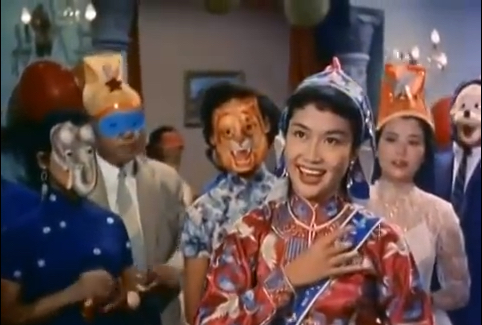
“I am not a party girl.”
Seemingly, this quote looks like a kind of declaration that sorts herself into a particular genre, timeline, spa-tial consciousness and image. The remaining images of this particular person, either in terms of time for its extension and fracture ,day and night, forward and backward ;or in terms of space for its segmentation and composition ,brightness and darkness, suspension and leap, are being given input into personal im-age(film)index system in thousands upon thousands of combination ways. The images are being constructed and then given out as an output. Therefore, it is no longer important whether I am a party girl or not. It is perhaps (or perhaps not) a lie. “Party” stirs up personal image(film) that is almost auto generated from our mind.
[Au Sow Yee] Difficulties of Historical / Time (Image): Sarong, Frank, Painter, Jim, Moonlight and Fire
(Author: Au Sow Yee; translator: Cliff Chang / Origin link)
This is not … the record of a traveler’s experiences in a foreign land. It is a series of sketches of Malay scenery and Malay character drawn by one who has spent the best part of his life in the scenes and amongst the people described.
These pages contain no statistics, no history, no geography, no science, real or spurious, no politics, no moralising, no prophecy - only an attempt to awaken an interest in an almost undescribed but deeply interesting people, the dwellers in one of the most beautiful and least known countries in the East.[1]Maybe we should start from a secret, or should we say, an image.
2017/06/07
[LiteraCity 2016] An Interview with Amir Muhammad
(Author: LiteraCity; originally published in LiteraCity Festival 2016)
Amir Muhammad is a casual filmmaker, writer and publisher at Buku Fixi. We met Amir Muhammad at Khadijah’s Kitchen after an event at Gerak Budaya, Petaling Jaya. He opened up the discussion to the exploration of Malay film world in the studio era and English theater world.
Amir Muhammad: Maybe not dramatically, but psychologically. If we observe writers like Hamzah Hussein and A. Samad Said, they were formerly based in Singapore, and later moved here. This includes P. Ramlee who was also a writer but specializes in screenplays. There was an attempt to recreate KL myths, because before them, KL was not considered a sexy city. The city was not a harbour, so its romance was different. KL was considered to be a place infected with malaria. In the process of establishing KL, many have died. People were not used to the environment back then. So in the 1960s, there were efforts to develop the image of KL myths.
Amir Muhammad is a casual filmmaker, writer and publisher at Buku Fixi. We met Amir Muhammad at Khadijah’s Kitchen after an event at Gerak Budaya, Petaling Jaya. He opened up the discussion to the exploration of Malay film world in the studio era and English theater world.
Amir Muhammad: Maybe not dramatically, but psychologically. If we observe writers like Hamzah Hussein and A. Samad Said, they were formerly based in Singapore, and later moved here. This includes P. Ramlee who was also a writer but specializes in screenplays. There was an attempt to recreate KL myths, because before them, KL was not considered a sexy city. The city was not a harbour, so its romance was different. KL was considered to be a place infected with malaria. In the process of establishing KL, many have died. People were not used to the environment back then. So in the 1960s, there were efforts to develop the image of KL myths.
[LiteraCity 2016] An Interview with A Samad Said
(Author: LiteraCity; originally published in LiteraCity Festival 2016)
With more than six decades of being involved in the writing scene, cities are his playground. Our fourth Malaysian National Laureate who are prefer to be called as “Bapak”, born in Durian Tunggal, Melaka and brought up in two different cities, Singapore and Kuala Lumpur. The interview was held at Masjid Negara, one of his most favourite spaces in the cities every time the call for prayer is called. In this interview, LiteraCity trails his fragments and memories growing in this two cities and how literature observes how the historical events unfold.
A. Samad Said: There is a long poem written by Ahmad Kamal Abdullah. If I am not mistaken, the title is “Kuala Lumpur, Kuala Lumpur” and it was staged. So, to say that there are no (works talking about Kuala Lumpur), it might be a mistake. His poem was specifically written about Kuala Lumpur and it was made into a musical, danced to, and staged
With more than six decades of being involved in the writing scene, cities are his playground. Our fourth Malaysian National Laureate who are prefer to be called as “Bapak”, born in Durian Tunggal, Melaka and brought up in two different cities, Singapore and Kuala Lumpur. The interview was held at Masjid Negara, one of his most favourite spaces in the cities every time the call for prayer is called. In this interview, LiteraCity trails his fragments and memories growing in this two cities and how literature observes how the historical events unfold.
A. Samad Said: There is a long poem written by Ahmad Kamal Abdullah. If I am not mistaken, the title is “Kuala Lumpur, Kuala Lumpur” and it was staged. So, to say that there are no (works talking about Kuala Lumpur), it might be a mistake. His poem was specifically written about Kuala Lumpur and it was made into a musical, danced to, and staged
[LiteraCity 2016] Perceiving Urban Literature
(Author: Zikri Rahman; originally published for LiteraCity Festival 2016)
From the depths of imagination and actual places traced by writers and theirs characters in literature, the city of Kuala Lumpur becomes alive, and will forever be so, with more 110 works of literature speaking of the city and everything in between. However, understanding Kuala Lumpur through its works of literature it is not as easy undertaking as other big cities worldwide. In James Joyce’s Dubliners about the city Dublin and Naguib Mahfouz’s Cairo Trilogy about Cairo, the manifestation of cities in both novels are considered to be the greatest in literature. Their novels are gracefully written, exploring every nook and corner of the city, from its architecture to every souls of its inhabitants. Both novels are now considered authoritative and part of the literary canon.
Fortunately for us, there is still room to freely and innocently explore Kuala Lumpur’s literature without the weight of a literary canon or authoritative work, in order to grasp and discover what the city of Kuala Lumpur means. Thus we are able to openly and moderately appreciate the city through various works of literature.
From the depths of imagination and actual places traced by writers and theirs characters in literature, the city of Kuala Lumpur becomes alive, and will forever be so, with more 110 works of literature speaking of the city and everything in between. However, understanding Kuala Lumpur through its works of literature it is not as easy undertaking as other big cities worldwide. In James Joyce’s Dubliners about the city Dublin and Naguib Mahfouz’s Cairo Trilogy about Cairo, the manifestation of cities in both novels are considered to be the greatest in literature. Their novels are gracefully written, exploring every nook and corner of the city, from its architecture to every souls of its inhabitants. Both novels are now considered authoritative and part of the literary canon.
Fortunately for us, there is still room to freely and innocently explore Kuala Lumpur’s literature without the weight of a literary canon or authoritative work, in order to grasp and discover what the city of Kuala Lumpur means. Thus we are able to openly and moderately appreciate the city through various works of literature.
[LiteraCity 2016] Mapping Kuala Lumpur Literature
(Author: Zikri Rahman; originally published for LiteraCity Festival 2016)
“...form and symbol of an integrated social relationship: it is the seat of a temple, the market, the hall of justice, the academy of learning. Here is where human experience is transformed into viable signs, symbols, patterns of conducts, systems of order.”The LiteraCity mapping project maps neither the contours of the Earth, nor the coordinates of a place. It does not want to know what already physically exists. Most importantly, the LiteraCity mapping project aims to uncover the layers of meaning – for this is how literature operates – where the project revolves around three aspects – space, the building of space and the interpretation of Kuala Lumpur’s body of literature in its process. The mapping of literature and culture’s space is thus a means to delve deeper into an alternative and counter discourse, as well as to produce an unconventional and abstract knowledge by looking into the urban community’s order.
– Lewis Mumford [1]
訂閱:
文章 (Atom)